| Home > Different Industrial Molding Processes > Extrusion Molding |
Extrusion Molding Process |
What is Extrusion Molding?
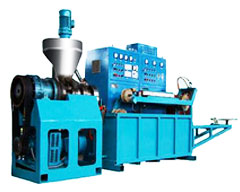 Extrusion moulding is a type of molding process where a continuous work piece is produced by forcing molten plastic through a shaped die. This is the most usedprocess to mass manufacture shapes with a constant cross section, like window molding, electronic enclosures, doorinsulation seals, pipes, rods, etc. A key advantage of extrusion molding is it's low cost which makes it a very cost efficient process to manufacture products with a continuous profile. There are different types of extrusion molding such as plastic extrusion molding, injection extrusion molding, rubber extrusion molding and roto extrusion molding.
The Extrusion Molding Process:
The machines employed in plastic extrusion moulding / injection extrusion moulding is very similar to those used in injection moulding. The thermo plastic granules are fed in the hopper where a a motor turns a screw and forces the plastic granules into the heater. As the plastic materials melt, they are pushed through the barrel into the die located at the end of the machine. The shape of the die determines the shape of the molded finished part. After the extrusion cools it may be cut into equal or desired lengths.
Extrusion Molding Design Considerations:
- Walls must not be too thick to provide cooling.
- Use rounded corners.
- Use uniform wall thickness.
- Long items will have a slight curvature.
- Ends are rough cut.
Advantages of Extrusion Molding:
Plastic or injection extrusion molding is comparatively a very cost efficient process. Even the machines, tools and equipments employed in the process are of low cost. Moreover the products/moulds so formed boosts of uniform wall thickness and has the ability to produce intricate profiles. The process of injection extrusion moulding provides a exclusive flexibility and hence is used to produce a wide range of products.
Feel free to contact us to buy extrusion molding machines, plastic extrsion moulding machines, injection extrusion molding machines, rubber extrusion molding machines, roto extrusion molding machines and products(plastic moulds) formed through this process; or for any query about any types of machines, tools & equipments used in extrusion molding processs.
|
| |
| |
 |